
Basement Waterproofing, Foundation Repair and Crawl Space Waterproofing Professionals
Budget Dry’s basement waterproofing provides each homeowner with the best solution to their basement waterproofing, crawl space waterproofing, and foundation repair problems. Our project managers will come to your home to review your basement situation, detecting basement leaks and identifying the source of the water. Something that’s not always understood by homeowners is that the air quality of a home built on top of a dirty crawl space can be greatly affected by moisture and harmful gasses that are released from the earth. These include the potentially cancer-causing gas Radon, as well as many other less dangerous yet still unpleasant allergens. We are passionate about providing the absolute best service to each home and homeowner we encounter because we understand just how important your home is to you. We pride ourselves on our excellent customer service and use of cutting edge industry technology. Budget Dry Basement Waterproofing is a leader in Basement waterproofing and basement restoration. Every Basement flood, leak or crack is evaluated thoroughly to ensure that we provide you with the best solution. So you can be secure and confident in the knowledge that Budget Dry treats the problem, not the symptom!
Facts About Danbury
Danbury was settled by colonists in 1685, when eight families moved from what are now Norwalk and Stamford, Connecticut. The Danbury area was then called Pahquioque by its namesake, the Algonquian-speaking Pahquioque Native Americans (they are believed to have been a band of the Paugusset people), who occupied lands along the Still River. Bands were often identified by such geographic designation but they were associated with the larger nation by culture and language). One of the original English settlers was Samuel Benedict, who bought land from the Paquioque in 1685, along with his brother James Benedict, James Beebe, and Judah Gregory. This area was also called Paquiack (“open plain” or “cleared land”) by the Paquioque. In recognition of the wetlands, the settlers chose the name Swampfield for their town. In October 1687, the general court decreed the name Danbury. The general court appointed a committee to lay out the new town’s boundaries. A survey was made in 1693, and a formal town patent was granted in 1702. During the American Revolution, Danbury was an important military supply depot for the Continental Army. Sybil Ludington, 16-year-old daughter of American Colonel Henry Ludington, made a 40-mile ride in the early hours of the night on April 26, 1777, to warn the people of Danbury and her father’s forces in Putnam County, New York, of the approach of British regulars, helping them gather in defense. During the following day on April 26, 1777, the British, under Major General William Tryon, burned and looted Danbury, but fatalities were limited due to Ludington’s warning.
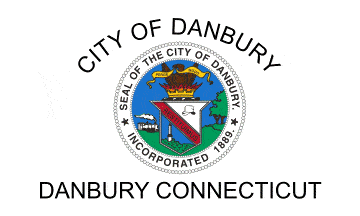
The central motto on the seal of the City of Danbury is Restituimus, (Latin for “We have restored”), a reference to the destruction caused by the Loyalist army troops. The American General David Wooster was mortally wounded at the Battle of Ridgefield by the British forces which had attacked Danbury, but at the beginning of the battle, the Americans succeeded in driving the British forces down to Long Island Sound. Wooster is buried in Danbury’s Wooster Cemetery; the private Wooster School in Danbury also was named in his honor. In 1802, President Thomas Jefferson wrote a letter to the Danbury Baptist Association, a group expressing fear of persecution by the Congregationalists of that town, in which he used the expression “Separation of Church and State”. It is the first known instance of the expression in American legal or political writing. The letter is on display at the Unitarian-Universalist Congregation of Danbury. The first Danbury Fair was held in 1821. In 1869, it became a yearly event; the last edition was in 1981. The fairgrounds were cleared to make room for the Danbury Fair Mall, which opened in autumn 1986.Kohanza Reservoir disaster, January 31, 1869; the dam was breached, releasing a flood on the town. “Scene of the Disaster at Danbury”, January 31, 1869 In 1835, the Connecticut Legislature granted a rail charter to the Fairfield County Railroad, but construction was delayed because of lack of investment. In 1850, the organization’s plans were scaled back, and renamed the Danbury and Norwalk Railroad. Work moved quickly on the 23 mi (37 km) railroad line. In 1852, the first railroad line in Danbury opened, with two trains making the 75-minute trip to Norwalk.
The central part of Danbury was incorporated as a borough in 1822. The borough was reincorporated as the city of Danbury on April 19, 1889. The city and town were consolidated on January 1, 1965. The first dam to be built on the river, to collect water for the hat industry, impounded the Kohanza Reservoir. This dam broke on January 31, 1869, under pressure of ice and water. The ensuing flood of icy water killed 11 people within 30 minutes, and caused major damage to homes and farms.[As a busy city, Danbury attracted traveling shows and tours, including Buffalo Bill’s Wild West Show in 1900. It featured young men of the Oglala Sioux nation, who re-enacted events from frontier history. Oglala Sioux Albbert Afraid of Hawk died on June 29, 1900, at age 21 in Danbury during the tour. He was buried at Wooster Cemetery. In 2012, employee Robert Young discovered Afraid of Hawk’s remains. The city consulted with Oglala Sioux leaders of the Pine Ridge Indian Reservation and arranged repatriation of the remains to the nation. Wrapped in a bison skin, the remains were transported to Manderson, South Dakota, to Saint Mark’s Episcopal Cemetery, for reburial by tribal descendants.
WHERE TO FIND US:
158 Route 81
Killingworth, CT 06419
203-421-8560
800-DRY-2211 (800-379-2211)