
A bowing basement wall is one of the clearest signs that a foundation is experiencing excessive lateral pressure. Homeowners may first notice a long horizontal crack along a concrete block mortar joint, stair-step cracking, separation near the corners, or a basement wall that appears to lean inward.
For homeowners in Connecticut and Western Massachusetts, seasonal moisture, groundwater, drainage conditions, soil characteristics, and freeze-thaw cycles can all contribute to pressure against below-grade foundation walls.
The good news is that a bowed wall does not automatically mean the entire foundation needs to be replaced. Depending on the wall material, severity of movement, site conditions, and underlying cause, professional foundation repair may involve carbon fiber reinforcement, wall anchors, tieback systems, steel reinforcement, drainage improvements, or more extensive structural repair.
Budget Dry Waterproofing provides foundation and basement evaluations throughout Connecticut and Western Massachusetts to help homeowners determine the appropriate repair strategy for their property.
What Causes Basement Walls to Bow in Connecticut?
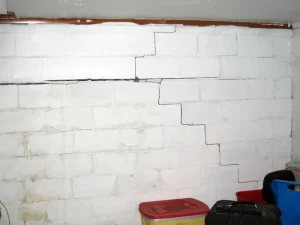
Basement walls are designed to withstand pressure from the soil surrounding the foundation. Problems can develop when lateral pressure becomes greater than the wall can safely resist.
Several conditions can contribute to bowed or cracked foundation walls.
Hydrostatic Pressure Around the Foundation
When soil around a foundation becomes saturated after heavy rain, snowmelt, or poor drainage, water increases the pressure exerted against basement walls.
Poor grading, clogged gutters, short downspouts, and inadequate exterior drainage can make the problem worse by allowing more water to accumulate near the foundation.
Over time, repeated pressure can contribute to horizontal cracks, inward movement, and water intrusion.
Connecticut Soil Conditions
Soil conditions vary significantly from property to property. Connecticut building standards recognize multiple soil classifications, including clay, sandy clay, silty clay, clayey silt, silt, sand, gravel, and rock.
Fine-grained soils can retain significant moisture, which makes proper drainage around the foundation especially important.
Because soil conditions differ even between neighboring properties, determining the cause of a bowed wall requires evaluating the home itself rather than assuming one soil condition applies throughout Connecticut.
Freeze-Thaw Cycles
Connecticut and Massachusetts foundations must also contend with cold winters.
Moisture in the soil can freeze and expand during winter conditions. Repeated freezing and thawing can change soil pressures around the foundation and contribute to movement over time, particularly when drainage problems are already present.
Poor Exterior Drainage
Foundation movement is not always caused by the wall itself.
Water repeatedly collecting beside the house can increase soil saturation and pressure against the foundation. That is why a professional evaluation should consider not only the visible crack or bow, but also:
- Gutters and downspouts
- Exterior grading
- Surface drainage
- Groundwater conditions
- Existing basement drainage systems
- Signs of water intrusion
Correcting the structural symptom without considering the moisture source may leave an important part of the problem unresolved.
Signs Your Basement Wall May Need Structural Repair
Not every foundation crack indicates serious structural movement, but certain patterns deserve prompt professional attention.
Common warning signs include:
- Long horizontal cracks across concrete block walls
- Stair-step cracks along mortar joints
- Inward bowing or bulging
- Cracks that continue to widen
- Separation where basement walls meet adjoining walls
- Water entering through foundation cracks
- Doors or windows becoming difficult to open
- Visible wall movement or displacement
A horizontal crack accompanied by visible inward movement is particularly important to evaluate because it may indicate lateral pressure against the foundation.
Carbon Fiber vs. Wall Anchors for Bowing Basement Walls
There is no single repair method that is appropriate for every bowed foundation wall.
The right solution depends on factors such as the amount and location of wall movement, foundation material, structural condition, exterior access, drainage conditions, and long-term repair goals.
Two commonly discussed approaches are carbon fiber reinforcement and wall anchor systems.
| Repair Method | Common Application | Exterior Excavation | Primary Purpose |
|---|---|---|---|
| Carbon Fiber Reinforcement | Cracked or bowing walls where stabilization is appropriate | Typically no | Reinforce and help prevent additional movement |
| Wall Anchors | Bowed walls where anchoring to stable soil is feasible | Usually required | Stabilize the wall and, in some situations, allow gradual adjustment |
| Tieback Systems | Properties with limited exterior access or specific structural conditions | Varies by system | Stabilize walls using anchors installed through the foundation |
| Major Structural Repair | Severely damaged, displaced, or compromised walls | Often extensive | Repair or reconstruct compromised sections |
The appropriate system should be selected after inspecting the actual foundation.
Carbon Fiber Foundation Repair
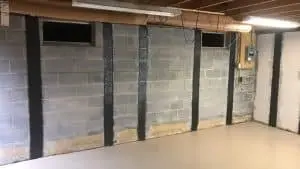
Carbon fiber reinforcement is a low-profile method used to strengthen certain cracked or bowing foundation walls.
The system generally involves preparing the wall surface and bonding high-strength carbon fiber reinforcement to the foundation using structural epoxy. Once installed correctly, the carbon fiber helps resist additional movement while adding minimal thickness to the wall.
Benefits of Carbon Fiber Reinforcement
Carbon fiber may be attractive because it can offer:
- Interior installation with little or no exterior excavation
- A thin, low-profile finished appearance
- High tensile strength
- Resistance to corrosion
- Minimal disruption to landscaping
- Structural reinforcement without rebuilding the wall
Budget Dry has used carbon fiber reinforcement on Connecticut foundation repair projects where cracked walls required additional structural support.
When Is Carbon Fiber Appropriate?
Carbon fiber is not automatically the right solution for every bowed wall.
Its suitability depends on the amount and type of movement, the condition and material of the foundation, and whether the goal is stabilization or physical repositioning of the wall.
A professional inspection is necessary to determine whether carbon fiber reinforcement is appropriate for a specific foundation.
Wall Anchor Systems
Wall anchors provide another method of stabilizing bowed basement walls.
A typical system connects an interior wall plate to an anchor installed in stable soil outside the foundation using a steel rod. This creates resistance against continued inward movement.
Depending on the system and structural conditions, some wall anchor installations may also allow controlled adjustment over time.
Benefits of Wall Anchors
Wall anchors may provide:
- Structural stabilization for bowed foundation walls
- Resistance against continued inward movement
- Potential for gradual adjustment in appropriate situations
- A repair alternative to rebuilding the entire wall
The main limitation is exterior access. Traditional wall anchor systems generally require sufficient space outside the home to install the earth anchors, which may be difficult on properties with neighboring structures, driveways, patios, utilities, or limited lot space.
Which Bowing Wall Repair Method Is Best?
The best repair cannot be determined from the crack alone.
A foundation professional should evaluate:
- How far the wall has moved – Greater displacement may require a different structural approach.
- Foundation material – Concrete block and poured concrete walls can fail differently.
- Crack pattern – Horizontal, vertical, diagonal, and stair-step cracks provide different clues.
- Exterior access – Property lines, landscaping, utilities, patios, and driveways can affect repair options.
- Water and drainage conditions – Ongoing hydrostatic pressure should be addressed as part of the overall solution.
- Condition of the wall – Significant deterioration or displacement may require more extensive structural work.
This is why homeowners should be cautious of choosing a repair system based solely on an online cost chart or a single measurement.
How Much Does Bowing Basement Wall Repair Cost in Connecticut?
The cost of bowing basement wall repair in Connecticut varies considerably from one home to another.
Pricing depends on factors such as:
- Length of the affected wall
- Severity of bowing or displacement
- Foundation material
- Number of reinforcement points required
- Repair system selected
- Accessibility
- Exterior excavation requirements
- Drainage or waterproofing work
- Additional structural damage
Carbon fiber reinforcement may require less excavation and site disruption than anchor systems or major structural reconstruction, but the least expensive repair is not necessarily the correct repair.
For an accurate estimate, the foundation should be inspected so the cause and severity of movement can be evaluated before a repair plan is recommended.
Does Waterproofing Matter When Repairing a Bowed Wall?
Often, yes.
If excessive water around the foundation is contributing to soil pressure, structural stabilization may address the wall movement while drainage or waterproofing improvements address an underlying source of pressure.
Depending on the property, this could include improvements to exterior drainage, grading, gutters and downspouts, or basement waterproofing and drainage systems.
Budget Dry provides both foundation crack repair and basement waterproofing services, allowing the wall condition and moisture problem to be evaluated together.
Bowing Basement Wall Repair in Connecticut & Western Massachusetts
Foundation problems are highly property-specific. Soil, drainage, foundation construction, age, grading, and previous repairs can vary significantly from one home to another.
Budget Dry Waterproofing serves homeowners throughout Connecticut and Western Massachusetts, with Connecticut locations in Killingworth and Danbury.
Our team evaluates basement and foundation problems to determine what is causing the visible damage and which repair approach makes sense for the home.
If you notice horizontal cracking, inward movement, recurring foundation leaks, or other signs of foundation damage, having the wall evaluated early can help determine whether stabilization is needed before the condition progresses.
Frequently Asked Questions About Bowing Basement Walls
Can carbon fiber repair a bowing basement wall?
Carbon fiber reinforcement can be used to stabilize certain cracked or bowing foundation walls. Whether it is appropriate depends on the amount and type of movement, foundation material, wall condition, and other structural factors. An on-site evaluation is needed before selecting a repair method.
Are horizontal basement wall cracks serious?
Horizontal cracks can indicate lateral pressure against a foundation wall, particularly when accompanied by inward bowing or displacement. Because the severity cannot be determined from the crack pattern alone, homeowners should have significant or changing horizontal cracks professionally evaluated.
Can a bowed basement wall be straightened?
Some bowed walls may be candidates for controlled adjustment or straightening, while others are better stabilized in their existing position. The appropriate approach depends on the severity of movement, condition of the wall, exterior access, and structural characteristics of the foundation.
What is better for a bowed wall: carbon fiber or wall anchors?
Neither system is universally better. Carbon fiber can provide low-profile reinforcement without major exterior excavation in appropriate applications, while wall anchors can provide stabilization where sufficient exterior access exists. The wall’s condition and movement should determine the repair method.
How much does bowed wall repair cost in Connecticut?
There is no reliable single price for bowed wall repair because costs depend on wall length, severity, foundation type, access, repair method, and whether drainage or waterproofing improvements are also needed. An on-site foundation inspection provides the most accurate estimate.
Does homeowners insurance cover bowing basement walls?
Coverage depends on the policy and the cause of the foundation damage. Some causes of structural movement or water damage may be excluded. Homeowners should document the damage and contact their insurance provider to determine what their specific policy covers.
Should I repair drainage problems when fixing a bowed basement wall?
If water accumulation and saturated soil are contributing to pressure against the foundation, drainage improvements may be an important part of the overall repair strategy. Gutters, downspouts, grading, exterior drainage, and basement waterproofing should be evaluated along with the structural condition.
Schedule a Foundation Inspection in Connecticut
A bowing basement wall is not something to diagnose from appearance alone. The amount of movement, foundation construction, drainage conditions, and cause of the pressure all affect the appropriate repair.
Budget Dry Waterproofing provides foundation repair, crack repair, and basement waterproofing services throughout Connecticut and Western Massachusetts.
If you’ve noticed horizontal cracks, inward wall movement, or recurring water intrusion, schedule an evaluation before the problem has an opportunity to progress.
Request Your Free Basement & Foundation Inspection

Budget Dry is based in Killingworth, Connecticut and has been recognized as the areas leading basement waterproofing and foundation repair company.
We are passionate about providing the absolute best service to each home and homeowner we encounter, because we understand just how important your home is to you. We pride ourselves on our excellent customer service and use of cutting edge industry technology.
Budget Dry Basement Waterproofing is a leader in Basement waterproofing and basement restoration. Every Basement flood, leak or crack is evaluated thoroughly to ensure that we provide you with the best solution. So you can be secure and confident in the knowledge that Budget Dry treats the problem, not the symptom!