For many homeowners in Connecticut and Western Massachusetts, the crawl space is a forgotten dark corner of the home. However, this small area beneath your feet plays a massive role in the structural integrity and air quality of your entire living space. If you are noticing a musty smell in your living room or experiencing cold floors in the winter, you are likely facing a crawl space issue. But when it comes to a solution, should you simply add more insulation, or is total crawl space encapsulation the better investment? At Budget Dry Waterproofing, we believe in fixing the root cause of the problem to ensure a healthy home environment.
The Hidden Impact of Your Crawl Space on Indoor Air Quality
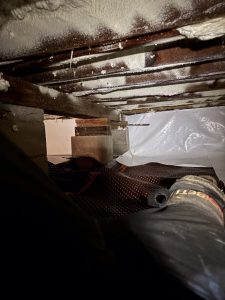
It is a common misconception that the air in your crawl space stays in the crawl space. In reality, your home acts like a large chimney. This phenomenon is known as the “stack effect.” As warm air rises and escapes through your attic and upper levels, it creates a vacuum that pulls air upward from the lowest point of the building, your crawl space.
Understanding the “Stack Effect” in Northeast Homes
In the Northeast, the stack effect is particularly strong during the winter months. As you turn up the heat, the rising air draws up as much as 50% of the air you breathe in your living areas directly from your crawl space. If that crawl space is damp, moldy, or filled with radon gas, those contaminants are being circulated throughout your home, potentially affecting your family’s respiratory health.
Why Musty Smells in the Living Room Start Under Your Feet
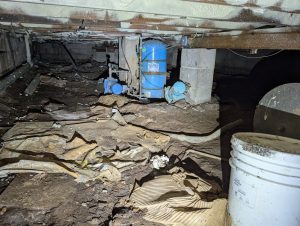
That classic “musty basement smell” is actually the byproduct of mold and microbial volatile organic compounds (mVOCs). When organic materials like wood joists or paper-backed insulation are exposed to high humidity, they become a breeding ground for fungi. Encapsulation addresses this by removing the moisture source, effectively neutralizing the odor at its origin.
Why Traditional Fiberglass Insulation Fails in Crawl Spaces
For decades, the standard practice was to install fiberglass batt insulation between the crawl space floor joists. While this works in a climate-controlled attic, it is often a recipe for disaster in a damp, unconditioned crawl space.
Moisture Retention and the Risk of Sagging Insulation
Fiberglass is highly porous and acts like a sponge. In a high-humidity environment, the insulation absorbs moisture from the air. This added weight causes the batts to sag and eventually pull away from the subfloor, leaving your home unprotected. Even worse, once fiberglass becomes wet, its R-value (insulating power) drops significantly, meaning you are paying for insulation that isn’t actually keeping you warm.
Creating a Breeding Ground for Mold and Pests
Wet insulation trapped against wooden floor joists creates a perfect environment for wood rot. Additionally, pests such as mice and termites find fiberglass batts to be an ideal nesting material. Traditional insulation does nothing to stop the entry of moisture or pests; it simply provides them with a place to hide and thrive.
The Process of Total Crawl Space Encapsulation
Encapsulation is a comprehensive solution that transforms a damp, dirty crawl space into a clean, dry, and conditioned part of your home. Unlike simple insulation, encapsulation creates a permanent barrier between your home and the earth.
Sealing with the CrawlShield™ Vapor Barrier
The core of our encapsulation system is the CrawlShield™ vapor barrier. This is a heavy-duty, multi-layer reinforced liner that is installed over the crawl space floor and walls. Unlike thin plastics found at hardware stores, this professional-grade liner is durable enough to crawl on and is specifically designed to prevent moisture and soil gases like radon from entering the space.
Why Dehumidification is the Final Piece of the Puzzle
Once the space is sealed from the outside earth and air, we install a high-performance, Sump Pump Geeks-approved dehumidification system. This unit maintains the relative humidity below 50%, which is the threshold for mold growth. By controlling the humidity, we ensure that the wood remains dry and the air remains healthy.
Energy Efficiency Benefits of a Dry Crawl Space
Encapsulating your crawl space isn’t just about health; it’s about your wallet. When your crawl space is at the same temperature and humidity as your home, your HVAC system doesn’t have to work nearly as hard. Homeowners who opt for encapsulation often see a significant reduction in their monthly heating and cooling costs because they are no longer trying to condition air that is constantly being replaced by humid or freezing outdoor air.
FAQ: Crawl Space Health and Maintenance
Q: What is the main difference between a vapor barrier and encapsulation? A: A simple vapor barrier typically only covers the ground. Total encapsulation seals the ground, the foundation walls, and all exterior vents, creating a completely controlled environment that is separate from the outdoors.
Q: Does crawl space encapsulation stop mold from growing? A: Yes. Mold requires a humidity level above 60% and a food source. By sealing the space and using a dehumidifier to keep humidity low, you remove the conditions necessary for mold to survive.
Q: How long does the encapsulation process take? A: Most crawl spaces in Connecticut can be fully encapsulated in 1 to 2 days. The result is immediate, and you will often notice an improvement in air quality and floor temperature within 24 hours.
Is your crawl space making your home “sick”? Don’t settle for temporary fixes. Contact Budget Dry Waterproofing today for a free crawl space inspection and take the first step toward a healthier home for your family.

Budget Dry is based in Killingworth, Connecticut and has been recognized as the areas leading basement waterproofing and foundation repair company.
We are passionate about providing the absolute best service to each home and homeowner we encounter, because we understand just how important your home is to you. We pride ourselves on our excellent customer service and use of cutting edge industry technology.
Budget Dry Basement Waterproofing is a leader in Basement waterproofing and basement restoration. Every Basement flood, leak or crack is evaluated thoroughly to ensure that we provide you with the best solution. So you can be secure and confident in the knowledge that Budget Dry treats the problem, not the symptom!