
Most homeowners rarely think about their crawl space—until floorboards start sagging, utility bills spike, or a persistent musty smell drifts up through the floor vents. In Connecticut and Western Massachusetts, traditional dirt crawl spaces absorb thousands of gallons of soil groundwater every year. This constant humidity turns sub-floor framing into a breeding ground for wood rot, mold, and pest infestations.
The permanent fix is crawl space encapsulation: completely sealing the ground and foundation walls with a heavy-duty vapor barrier, turning an open damp cavern into a clean, energy-efficient, conditioned asset.
The Stack Effect: How Your Crawl Space Dictates First-Floor Air Quality
Why does a damp subfloor make your living room smell like a basement? The answer lies in building science: the stack effect. As warm air rises naturally and escapes through your attic, it creates a powerful upward vacuum throughout your home. This suction forces warm, humid air up from the lowest point in your house.
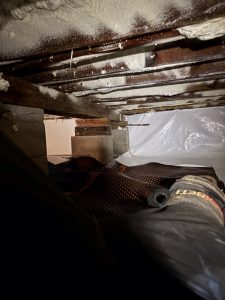
Key Air Quality Fact: Studies show that up to 50% of the air you breathe on your home’s first floor originates directly from your crawl space or basement.
When an unsealed dirt crawl space builds high humidity, that air delivers microscopic mold spores, dust mite allergens, and soil gases straight into your bedrooms and kitchen vents. Encapsulation stops this upward contamination at the source.
Open Vents vs. Complete Crawl Space Encapsulation
For decades, older New England building codes called for open foundation vents. Modern moisture experts now know open vents do far more harm than good—especially during humid summer months when hot outside air enters, condenses instantly on cold subfloor pipes, and saturates wood joists.
| Feature | Open Vented Dirt Crawl Space | Full Vapor Barrier Encapsulation |
|---|---|---|
| Moisture Control | Traps seasonal summer humidity | 100% sealed against soil groundwater & vapor |
| Wood Protection | High risk of rot, mold & structural sag | Keeps subfloor joists permanently dry |
| Energy Efficiency | Severe heating & cooling loss | Reduces HVAC energy bills by 15%–18% |
| Indoor Air Quality | Musty odors, spores & allergen drift | Clean, allergen-reduced indoor air |
The 4 Key Components of a Professional Encapsulation System
A true encapsulation isn’t just laying down a tarpaulin. It is an engineered system designed to isolate your home from ground moisture completely:
- Heavy-Duty Reinforced Vapor Barrier: A thick, multi-ply 20-mil puncture-resistant liner sealed continuously across the dirt floor, foundation piers, and up the masonry walls.
- Thermal Wall & Rim Joist Insulation: Rigid foam panels installed along foundation perimeter walls to block outside thermal drafts and prevent rim joist condensation.
- Airtight Vent Covers & Access Doors: Sealing open foundation vents and exterior hatches so humid outdoor air and winter frost cannot penetrate.
- Commercial-Grade Dehumidification: Installing a high-efficiency system (such as the
WiseAireunit) that automatically holds relative humidity below 50%.
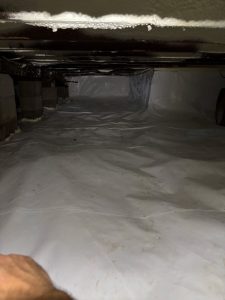
What Does Crawl Space Encapsulation Cost in CT & MA?
In Connecticut, professional crawl space encapsulation costs typically range between $5,000 and $15,000+ depending on total square footage, head-clearance, existing mold remediation needs, and whether interior drainage or sump pumps are required. While it is an investment, it routinely pays for itself by preventing thousands in structural wood repairs and reducing monthly heating and cooling costs.
Frequently Asked Questions
Can crawl space encapsulation fix sagging or bouncy floor joists?
Encapsulation stops future wood decay by removing moisture. However, if structural floor joists are already weakened, sistering new lumber or installing adjustable steel jack posts will safely level and reinforce the subfloor.
Should crawl space vents be opened in the summer in Connecticut?
No. Opening vents during humid summers allows hot, moist outside air to enter your cool crawl space where it condenses on cold water pipes and floor joists. Vents should be permanently sealed as part of encapsulation.
How long does a professional vapor barrier liner last?
High-grade, multi-ply reinforced 20-mil vapor barriers installed by certified contractors are engineered to last 20+ years without tearing or deteriorating under normal home usage.
Transform Your Dark, Damp Crawl Space Into a Dry, Clean Asset
Protect your home’s structural integrity, health, and energy bills with Budget Dry Waterproofing’s custom crawl space encapsulation systems. Schedule Your Free Crawl Space Inspection

Budget Dry is based in Killingworth, Connecticut and has been recognized as the areas leading basement waterproofing and foundation repair company.
We are passionate about providing the absolute best service to each home and homeowner we encounter, because we understand just how important your home is to you. We pride ourselves on our excellent customer service and use of cutting edge industry technology.
Budget Dry Basement Waterproofing is a leader in Basement waterproofing and basement restoration. Every Basement flood, leak or crack is evaluated thoroughly to ensure that we provide you with the best solution. So you can be secure and confident in the knowledge that Budget Dry treats the problem, not the symptom!