
Every home settles over time, but there is a fine line between a harmless hairline concrete crack and a structural failure that threatens your entire property investment. For homeowners across Connecticut, mistaking a structural emergency for a simple cosmetic blemish can lead to catastrophic repair costs down the road.
The High-Stakes Reality: Ignoring structural warning signs can ruin a real estate transaction, devalue your home by tens of thousands of dollars, and eventually compromise your living space’s safety.
The Environmental Triggers Driving Foundation Shifts in CT
Your home doesn’t sit on static ground. The diverse soils across Connecticut—ranging from dense glacial till in Litchfield County to expansive clay beds in the Hartford basin—react dramatically to weather changes. When heavy New England seasonal rains saturate these soils, they expand, creating a massive force known as hydrostatic pressure against your basement walls.
Conversely, during hot, dry summer stretches, the soil shrinks away from your home, leaving a vacuum that causes the foundation to shift outward. Layer in our intense winter freeze-thaw cycles—where groundwater expands by nearly 9% as it turns to ice—and your poured concrete or stone foundation is subjected to a relentless pushing and pulling force year after year.
How to Diagnose the Issue: Structural Failures vs. Cosmetic Settling
Because concrete naturally shrinks as it cures and dries, almost every home will develop minor blemishes. However, you must know how to distinguish normal aging from severe structural movement before investing in repairs or putting your home on the market.
Red Flags for True Structural Damage
- Horizontal Cracking: Fractures that run horizontally along mortar joints or concrete walls are almost always caused by heavy lateral soil pressure pushing the wall inward.
- Bowing or Leaning Walls: If a basement wall is noticeably bulging or leaning inward at the center, the structural integrity of the foundation has been severely compromised.
- Stair-Step Cracking: Stair-step patterns trailing through concrete blocks or brickwork indicate uneven foundation settlement.
- Main-Level Distortions: Stacking issues such as jamming first-floor doors, slanted window frames, or severe drywall cracks above the basement perimeter mean the framing is sinking.
Signs of Normal Concrete Shrinkage
In contrast, vertical hairline cracks (less than 1/16-inch wide) that form uniformly within the first few years of construction are typically non-structural. These occur as the concrete naturally sheds excess moisture and cures, though they can still act as pathways for water intrusion if left unsealed.
Professional Structural Stabilization vs. Superficial DIY Crutching
When a homeowner spots a crack, the gut reaction is often to run to the local hardware store for a tub of hydraulic cement or silicone caulk. While these retail patches might temporarily mask a cosmetic blemish, they are completely useless against active structural failure.
If the earth outside is actively pushing your foundation wall inward, a surface patch will simply crack, peel, and fail within a matter of months under the weight of hydrostatic pressure. True structural stabilization requires an engineered approach that halts structural movement in its tracks.
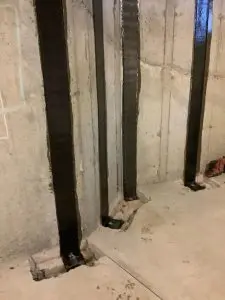
At Budget Dry, we utilize advanced carbon fiber straps and structural wall anchors. Carbon fiber is a space-age material that is physically stronger than steel yet less than a millimeter thick. When bonded directly to bowing basement walls, it links the foundation permanently back to the home’s structural framing, stopping lateral movement entirely without taking up valuable floor space.
Budget Dry’s Independent Engineering Edge
As an independent, non-franchise company based out of Killingworth, CT, Budget Dry doesn’t rely on pre-packaged, corporate repair kits or rigid corporate sales scripts. We understand that an 18th-century fieldstone basement in Middlesex County requires a fundamentally different engineering approach than a modern poured concrete foundation in New Haven.
Our independent status gives us the absolute freedom to select and custom-engineer a stabilization plan tailored precisely to your property’s age, concrete density, and local soil conditions, ensuring a permanent fix backed by a Transferable Lifetime Warranty.

Frequently Asked Questions
Q: Can a house pass inspection with structural foundation cracks?
A: Generally, no. Standard home inspectors are trained to flag horizontal cracks, bowing walls, or severe foundation settlement as major structural defects. Lending institutions will frequently deny mortgages on homes with unaddressed structural issues until a licensed professional contractor completes a permanent foundation stabilization repair.
Q: How much does structural foundation repair in CT usually cost?
A: Costs vary dramatically based on the severity of the damage and the number of walls affected. Minor non-structural crack injections can cost a few hundred dollars. In contrast, complete structural stabilization involving heavy-duty carbon fiber infrastructure typically ranges from several thousand to tens of thousands of dollars, depending on the home’s footprint.
Q: Will structural foundation repair lower my home’s resale value?
A: No, it does the exact opposite. Leaving an active structural flaw unaddressed severely slashes a home’s value and alienates prospective buyers. Completing a professional structural repair—backed by Budget Dry’s Transferable Lifetime Warranty—fully restores the home’s market value and gives buyers absolute peace of mind.
Structural movement never fixes itself; it only grows more dangerous and expensive over time. Protect your home’s equity before a minor shift becomes a structural crisis. Contact Budget Dry Waterproofing today to schedule a comprehensive foundation evaluation with our specialized local structural team.

Budget Dry is based in Killingworth, Connecticut and has been recognized as the areas leading basement waterproofing and foundation repair company.
We are passionate about providing the absolute best service to each home and homeowner we encounter, because we understand just how important your home is to you. We pride ourselves on our excellent customer service and use of cutting edge industry technology.
Budget Dry Basement Waterproofing is a leader in Basement waterproofing and basement restoration. Every Basement flood, leak or crack is evaluated thoroughly to ensure that we provide you with the best solution. So you can be secure and confident in the knowledge that Budget Dry treats the problem, not the symptom!